
Custom Software Development That Solves Complex Business Needs
and Drives Efficiency
Software shaped around your workflows, systems and operating constraints—not a generic product forced to fit.

- Built for your processes
- Integrates with existing tools
- Secure & maintainable
- Scalable for growth
What Is Software Development?
Custom software development designs and builds systems tailored to business requirements—workflows, data, integrations and the people who operate them day to day.
Who Needs Custom Software?
- Your processes are unique enough that packaged tools leave costly gaps
- Teams have outgrown spreadsheets, email chains or disconnected apps
- You need automation with clear ownership and failure handling
- Existing systems must stay while a better path is designed
Business Benefits of a Custom Solution
Improves efficiency
Reduce avoidable handoffs in the workflows that matter.
Fits your processes
Shape the product around how work actually happens.
Centralises information
Keep records where the right roles can use them.
Scales with the business
Start with a useful release, then extend with evidence.
Supports better decisions
Reporting that reflects real operational data.
Our Software Development Services
Areas an engagement can cover—your proposal states which apply, who owns hosting and what the first release includes.
Custom software development
Build around real workflows and a defined first release.
Business process automation
Replace manual steps with rules the system can own.
System design & architecture
Boundaries, roles and components before heavy build.
API development & integrations
Connect where access and APIs allow—scoped clearly.
Data management & reporting
Models and views teams can trust for decisions.
Quality assurance & testing
Normal paths, failures and regression coverage.
Maintenance & support
Agreed care after launch with named ownership.
How a Software Solution Works
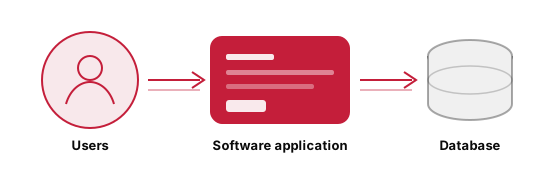
People use the application; the application reads and writes the data those roles need.
- Secure access
- Automated workflows
- Operational data
- System integrations
Examples of Software Solutions
Illustrative solution types—not a claim that every engagement includes all of them.
Operations management
CRM solutions
Inventory management
Booking & scheduling
ERP & business systems
Custom enterprise tools
Our Development Process
A clear sequence from discovery to a system you can operate.
Discover
Users, workflows and constraints.
Plan & design
Scope, architecture and UX.
Develop
Build the agreed first release.
Test
Normal paths and failure cases.
Deploy
Launch with named ownership.
Support
Care when scope includes it.
What Progress Can Look Like
Directional outcomes for a well-scoped engagement—not guarantees of headcount savings or revenue lift.
Streamlined operations
Core workflows live in a system the team can use.
Clearer productivity
Fewer manual bridges between tools—where scope allows.
Better information flow
Roles see the records they need without scavenger hunts.
A maintainable foundation
Ownership and architecture ready to extend—not an ROI guarantee.
Frequently Asked Questions
Straight answers about build vs buy, timing and ownership.
How is custom software different from off-the-shelf tools?
Custom software is shaped around your workflows and constraints. Packaged tools can be faster to adopt when they already fit; custom work makes sense when the gap is costly or blocking.
Should we buy software instead of building it?
Sometimes. Discovery should compare suitable existing products with custom work, including integration effort and ongoing ownership costs.
How long does a project take?
Timing depends on scope, integrations, data migration and decision speed. A first release should be sized so it delivers a useful workflow—not every future feature.
Can existing software be improved rather than replaced?
Potentially. It depends on access, technical condition, licences, dependencies and whether the current architecture can support the required changes.
Who owns the source code?
Ownership, licences and reuse rights must be stated in the contract. Do not assume that all third-party components can be transferred without conditions.
Ready to Build a Custom Software Solution?
Tell us which process needs to change, what systems already exist and who will own the result. We can use that context to define a suitable next step.